
21st Century Learning Design
21st Century Learning Design is an approach to teaching focused on helping learners develop skills they need for work and life. There are six key ideas at the heart of 21st Century Learning Design, which are listed below:
- Knowledge construction requires learners to go beyond memorizing information to analyzing, interpreting, synthesizing, and evaluating information. They must then apply their new knowledge in new contexts to make connections across multiple disciplines.
- Collaboration involves learners working together, sharing responsibility, and making substantive decisions. At the deepest level of collaboration, learners’ work is interdependent.
- Real-world problem solving and innovation involve a task with a defined challenge for learners. The problems must be authentic situations outside of an academic context so that learners can implement their solutions in the real world.
- Skilled communication requires learners to produce extended or multi-modal communication using evidence to support their ideas. At its deepest level, learners craft their communication for a specific audience.
- Self-regulation requires learners to work on an activity for an extended period. It requires learners to plan their work by breaking up their responsibilities. They must also have opportunities to revise their work based upon their own reflection and feedback from others (peers, educators, or experts).
- ICT for learning examines learners’ use of technology to support knowledge construction and encourages learners to become designers of ICT products that others use.
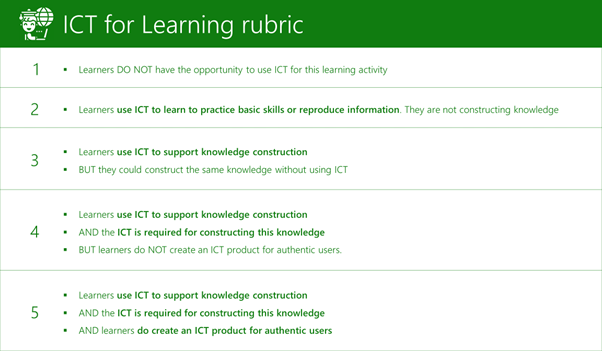
Each of these foci has a rubric against which teachers can evaluate their practice. The higher the rating on the rubric, the more embedded the element of 21st Century Learning Design is. Teachers can use this to refine and enhance their teaching. The rubric above is particularly interesting as it relates to ICT for learning.
One of the strengths of 21st Century Learning Design is that it focuses on ensuring the curriculum delivered helps to develop skills in the classroom and beyond. It can enable teachers to approach curriculum design differently and drive pedagogy innovation. Though there are several positives for this approach it does require significant CPD and training to equip teachers to be able to use it effectively.